
Car Crash Simulator: Mountain
Moon Star Games YazilimRacing
3.5176.00 Reviews
- Version
- 3.0.45t
- Installs
- 1.00M
- Age Rating
- Everyone
Screenshots
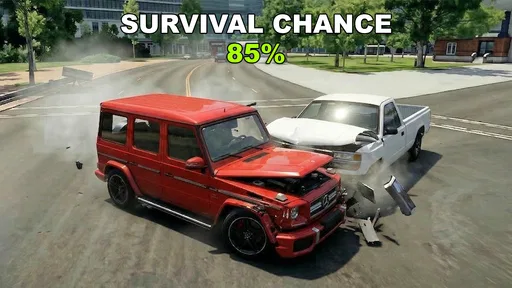
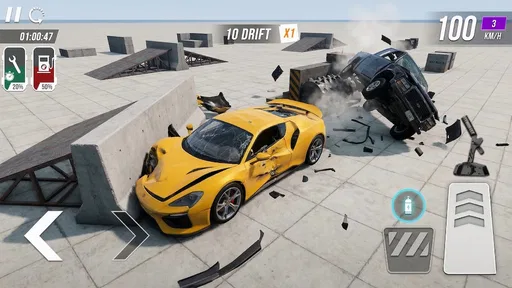
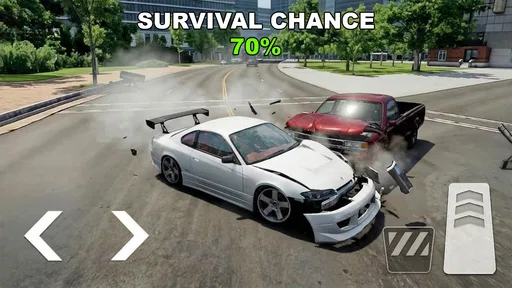
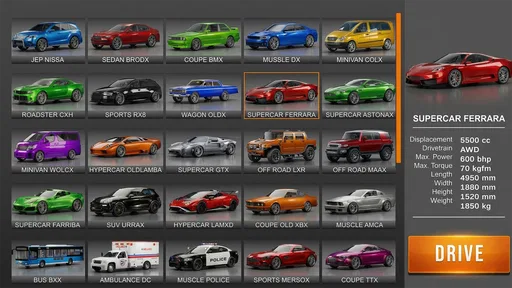
Our Review of Car Crash Simulator: Mountain
 Analysis by Appyee
I spent time with Car Crash Simulator: Mountain expecting a simple driving toy, but its appeal is more specific than that. This is a free racing game from Moon Star Games Yazilim built around difficult mountain roads, awkward recoveries, and the entertaining damage that follows when a car meets a slope, barrier, or bad decision. It is less about perfect lap times and more about seeing whether I can keep control when the road seems determined to throw me off it.
That focus makes it easy to understand within a few minutes, yet it also gives the game a different rhythm from a conventional racing title. I am not always chasing another driver or trying to shave a fraction from a circuit. Often, the challenge is simply reaching the next section without turning a manageable mistake into a spectacular wreck. For players who like driving experiments, tricky terrain, and soft-body crash behavior, that is a refreshing change of pace.
How the mountain driving feels right now
The current release is version 2.039t, and the game is available at no purchase cost for players using an operating system version 10 or later. It is rated for Everyone, so the presentation is accessible to a broad audience, although the driving itself can be surprisingly demanding. The store summary calls it a hardcore driving simulator, and I think that description is more useful than treating it as a standard arcade racer.
The mountain setting gives every run a practical problem to solve. A straight road would let me concentrate on speed, but steep routes force me to think about approach, steering corrections, and how much momentum is sensible before a turn. A fast entry can save time when the road opens up, but it can also leave the car with no room to recover. That tension is the main source of fun.
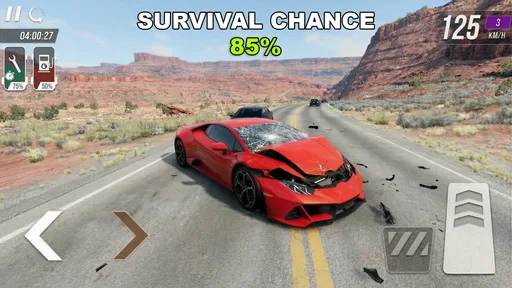
The crash system is the other defining element. A collision is not merely a quick reset or a dramatic animation placed over an otherwise unchanged vehicle. The soft-body behavior makes impacts feel like consequences inside the driving space. When I misjudge a bend, the result can be a messy loss of control rather than a clean, predictable failure. This encourages experimentation, because even a failed attempt can show exactly how a particular slope or obstacle punishes excessive speed.
I would not describe the handling as relaxing. The game asks for more attention than a casual traffic dodging experience, especially when the road narrows or changes direction quickly. That is good news for players who enjoy learning through repetition, but it may frustrate anyone looking for an effortless drive after work. The title is free, yet its central pleasure comes from mastering difficult situations rather than instantly feeling powerful.
A useful way to approach each run
My best results came from treating the first attempt on a section as reconnaissance instead of a serious record attempt. I watched where the road tightened, noticed which turns encouraged me to brake too late, and paid attention to how much control remained after a small bump. On the next run, I could make one deliberate change instead of repeating the entire mistake at full speed.
That approach also reveals an important trade-off. Going slowly is safer, but excessive caution can make the car harder to position on steep sections because I lose the momentum needed to clear them cleanly. The ideal pace is not simply “as slow as possible.” It is a controlled speed that leaves enough time to correct the steering while still carrying the car through the terrain.
One practical tip is to use crashes as information rather than treating them as wasted attempts. If the front of the car reaches an obstacle before the turn is complete, the problem may have started several seconds earlier with a poor line. If the rear swings out, the useful lesson may be that the entry was too aggressive rather than that the corner itself was impossible. This makes the game more rewarding for patient players than for people who only want immediate success.
The damage-focused design also creates a good short-session use case. I can play for a few minutes, test one route, and stop after learning something specific. It does not require the same commitment as a long championship or a structured career mode. At the same time, a player who enjoys repeating a challenge can stay longer because every attempt invites a slightly different approach.
What the latest release means for players
The game launched on November 29, 2024, and the present version, 2.039t, is the version I would use when judging its current state. That matters because early impressions of a driving game can change as handling and presentation evolve. Here, the version label gives existing players a clear point of reference when deciding whether to return after an earlier session.
I would be careful not to treat the version number as proof of a particular feature or improvement. What I can say from the current experience is that the core identity remains clear: mountain driving, difficult roads, and crash behavior are not side activities attached to a conventional racer. They are the reason to play. Players returning from an earlier installation should therefore expect the same fundamental kind of challenge rather than a complete change of genre.
The game has passed the early discovery stage with more than a million installs, and its average rating is 4.0 from roughly three thousand ratings. There are also over a hundred written reviews, which suggests that players are engaging with it beyond a single quick download. I read those figures as evidence of a reasonably established audience, not as a guarantee that every driver will enjoy the handling.
For someone deciding whether to try it now, the free entry point is helpful. I can test the driving style without committing money first, while optional purchases cost $2.49 per item. That makes the initial decision straightforward, but it also means I would pay attention to how comfortable I am with the basic experience before considering anything extra. The value depends on whether the crash-and-climb loop holds my attention, not simply on the fact that the download itself costs nothing.
How existing users may get more from it
Returning players should approach the current build with a small notebook habit, even if that sounds excessive for a mobile racer. I found it useful to remember one detail from each failed run: a turn that needed an earlier correction, a slope where speed was misleading, or a section where recovering from a slide was more effective than forcing the original line. That kind of mental record turns repeated crashes into gradual progress.
Another useful workflow is to separate control practice from route progress. Instead of trying to complete a difficult mountain section every time, I would spend a few attempts deliberately testing how the car reacts to small steering inputs at different speeds. Once I understood the response, I could return to the route with fewer frantic corrections. This is especially valuable for players who normally rely on instinct in arcade racers, because the mountain environment punishes last-second decisions.
The game also suits informal challenges between friends, even without treating it like a formal competitive title. One person can set a personal rule such as reaching a section without a major collision, while another can aim to finish with a more aggressive line. The interesting comparison is not always who is fastest; it can be who manages risk best. That gives the crash model a social use that a basic time trial may not provide.
On a phone, I would play with enough screen space to see the road clearly and avoid rushing inputs while holding the device awkwardly. Mountain driving depends on reading the next bend, so a distracted session is likely to produce poor results that say more about attention than ability. A short, focused session is usually better than playing while multitasking.
Where it differs from ordinary racing games
Compared with a typical arcade racer, this game puts less emphasis on traffic, spectacle, or constant forward acceleration. The mountain route itself is the opponent. That creates a slower, more deliberate style in which positioning matters as much as speed. Players who enjoy clean circuits and predictable braking points may find the terrain more interesting than a flat track, while players who want immediate overtaking action may feel that something is missing.
It also differs from a traditional driving simulator. I do not come to it for a broad catalogue of realistic vehicles, a detailed ownership system, or a long-form driving routine. Its simulation flavor is concentrated in the way the car reacts to difficult roads and impacts. That narrow focus is a strength because the game knows what it wants to deliver, but it is also a limitation for anyone seeking a complete automotive sandbox.
Against a pure crash game, the mountain layout gives the destruction more context. I am not simply launching a car into an obstacle and watching the result. I am trying to negotiate a route, and the crash is often the consequence of a decision made several seconds earlier. That makes successful control feel more satisfying than a random collision, even when the wreck itself is the most entertaining part.
The best alternative depends on what the player actually wants. If the priority is competitive racing with opponents, a conventional racing game is probably a better fit. If the priority is open-ended vehicle experimentation, a broader sandbox may offer more variety. I would choose this title specifically for the combination of steep roads, demanding control, and physical-looking crashes.
The friction points worth considering
The same focused design that makes the game distinctive can narrow its audience. Repetition is part of the intended loop, so players who need frequent changes of scenery or a strong progression structure may lose interest. The satisfaction comes from improving a run and understanding the road, not from constantly unlocking a new type of activity.
Difficulty can also feel uneven from a casual player’s perspective. A small error near a slope may create a much larger failure than expected, and recovering from a bad angle is not always intuitive on the first try. That is not necessarily a flaw in a hardcore driving game, but it does mean the title rewards patience more than quick experimentation without reflection.
The free-to-play structure deserves a sensible approach. Since optional purchases are priced at $2.49 per item, I would not buy anything immediately. I would first decide whether the core mountain driving remains enjoyable after several sessions. If the answer is yes, an optional purchase may feel reasonable; if the answer is no, spending money will not solve the underlying mismatch between the game’s focused loop and my preferences.
There is also a difference between amusing destruction and meaningful driving. Some players will enjoy the crash outcome more than the attempt that caused it. For me, the game works best when I care about reaching the next point safely and the collision exposes a mistake. If I only want spectacular wrecks with no need to manage a route, a dedicated crash-focused experience would likely be more direct.
Who should try it and who should skip it
I would recommend it to players who enjoy difficult mobile driving, mountain roads, and learning through repeated attempts. It is particularly suitable for someone who likes turning a failed run into a small technical lesson. The Everyone age rating makes it approachable in terms of content, but the challenge itself is not necessarily aimed at very young or impatient players.
It is also a good choice for short bursts of focused play. A realistic evening scenario would be opening the game after a commute, spending ten minutes testing one troublesome section, and stopping once the correct approach becomes clear. The game does not need to replace a full racing collection; it can serve as a compact driving challenge when I want control and consequences rather than a long campaign.
I would skip it if my main goal is online competition, a large progression system, or a broad selection of racing formats. I would also look elsewhere if I dislike restarting after mistakes or if I prefer cars to remain visually and mechanically unaffected by collisions. Those are not minor preferences here; they sit close to the center of the experience.
What I would watch in future updates
The most important thing to watch is whether future development deepens the existing mountain-driving idea without diluting it. More meaningful variation in routes, clearer reasons to revisit difficult sections, or refinements that make control easier to understand would strengthen the game while preserving its identity. I would value improvements that help players learn from a crash rather than simply making the car harder to damage.
I would also pay attention to how the current version develops for existing users. Since version 2.039t is the present reference point, any later change should be judged by its effect on the handling and the crash loop, not just by a larger version label. A new addition would be worthwhile if it creates fresh decisions on the mountain roads; it would be less useful if it merely adds noise around the central driving challenge.
For now, my recommendation is qualified but positive. This is best understood as a focused mountain-driving challenge, not a complete racing replacement. Moon Star Games Yazilim has chosen a clear idea and gives it enough room to stand apart from ordinary track racers. I enjoy it most when I slow down, study the road, and accept that a crash can be useful feedback.
If that sounds like your kind of mobile game, the free download makes trying it easy, and the current audience suggests it has already found plenty of interested drivers. Just bring patience, expect to repeat difficult sections, and judge optional spending only after the core loop proves itself. For me, Car Crash Simulator: Mountain earns a place among specialized racing games because its strongest moments come from the narrow space between staying in control and watching the mountain win.
Privacy and Permissions
See what permissions an app requests and how it handles your data.
- Wi-Fi connection information
- view Wi-Fi connections
- Other
- view network connections, full network access, control vibration, prevent device from sleeping, Google Play license check
Verdict
Strengths of Car Crash Simulator: Mountain
- Realistic mountain roads create tense and varied driving challenges.
- Simple controls make the game easy to pick up on mobile devices.
- Vehicle damage adds consequences to reckless driving.
- Offline play is convenient for gaming without an internet connection.
- Short sessions work well for quick entertainment on the go.
Limitations of Car Crash Simulator: Mountain
- Repetitive crash scenarios may reduce long-term replay value.
- Some vehicles and content may require in-app purchases or ads.
- Physics can feel inconsistent during extreme collisions.
- Graphics may look dated on newer phones and tablets.
- Limited customization may disappoint players seeking deeper progression.
Similar Picks in This Category
View All
Hill Climb Racing
Fingersoft4.3

Dr. Driving
SUD Inc.4.2

Traffic Rider
skgames4.5

Asphalt 8 - Car Racing Game
Gameloft SE4.6

Race Master 3D: Car Racing
Beresnev Games4.6

Extreme Car Driving Simulator
AxesInMotion Racing4.3
Frequently Asked Questions
What is Car Crash Simulator: Mountain?
Car Crash Simulator: Mountain is a driving and destruction game focused on realistic-looking vehicle crashes in mountainous environments. After testing it, the main appeal is experimenting with steep roads, ramps, obstacles, and dangerous drops rather than completing a traditional racing campaign. Players can drive vehicles, create collisions, and explore crash scenarios while enjoying physics-based destruction and dramatic mountain landscapes.
How do you play Car Crash Simulator: Mountain?
Gameplay is centered on controlling a vehicle through mountain tracks and deliberately navigating hazardous areas. You can accelerate, steer, brake, and attempt jumps or collisions with different obstacles. The experience is more about testing what happens during an impact than following strict racing rules. New players should begin carefully, learn the controls, and use open areas to understand the vehicle’s movement before attempting larger crashes.
Does Car Crash Simulator: Mountain work offline?
The game is generally designed as a standalone driving experience, so many of its core features can be used without a constant internet connection. Offline play is useful when you want to experiment with crashes while traveling or when mobile data is unavailable. However, advertisements, updates, analytics, or certain optional features may require connectivity, and availability can vary according to the version installed on your device.
Is Car Crash Simulator: Mountain suitable for children?
Although the game does not involve realistic human injury, it focuses heavily on vehicle accidents, destruction, and dangerous driving. Parents should review the store rating, advertising behavior, and in-app purchase information before allowing younger children to play. The controls are usually easy to understand, but the crash theme may not appeal to every child. Adult supervision is recommended, especially when the game is installed on a shared device.
What devices are compatible with Car Crash Simulator: Mountain?
Compatibility depends on the operating system, device model, available storage, and the minimum requirements listed on the official download page. The game should run best on relatively modern phones and tablets with sufficient memory, while older or entry-level devices may experience slower performance, longer loading times, or reduced visual quality. Check the current Android or iOS listing before downloading, since requirements and supported versions can change.
Play our best games!


